

Most organizations are good at developing strategic initiatives but not so good at making them meaningful to the employees who will be responsible for their successful execution. Not surprisingly, 80% of employees surveyed do not understand how organizational initiatives apply to them. It’s futile to expect exceptional performance under those conditions.
No matter how far along you are in your strategic planning process, your business and your employees will benefit significantly from translating top-level goals into something meaningful at the team and the individual levels.
I’ve created a Translating Strategic Initiatives Template to facilitate that process. The tool is meant to encourage a strategic level discussion not to use in developing tactical action plans. This exercise will foster alignment, ownership, and shed light on the most crucial work to be done.
If you’d like a copy of the Translating Strategic Initiatives Template, contact me and I’ll send it your way.
Translating Creates Ownership
Typically, fewer than 25% of employees surveyed strongly agree that the leadership of the organization has a clear direction for the company. Here is Leadership’s chance to explain the “why” behind the priorities and to provide the context that creates team engagement and buy-in.
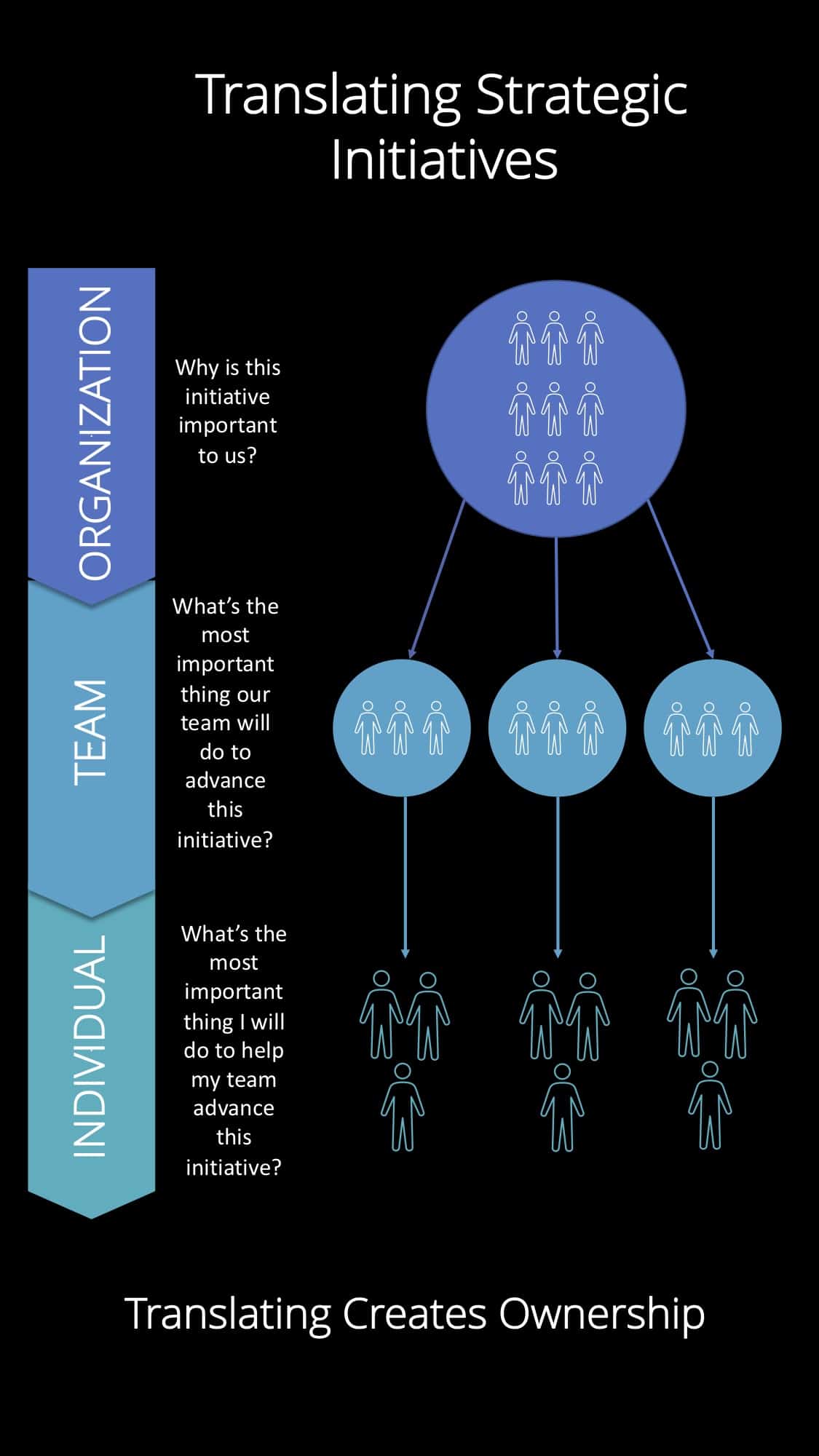
Check out the infographic above for an overview of how Translating Strategic Initiatives works.
For each strategic initiative, Leadership creates meaning by answering the question “Why is this initiative important to us?”
I’m not talking about taking the easy way out and using financial numbers or KPIs. You’ve got to go deeper to make it truly meaningful. Ask questions like: What will achieving this objective allow us to do? How will our organization be better off when we accomplish this initiative? How will we be able to serve our customers better? How does the initiative support our company’s Vision?
Providing a thoughtful “why” for each key strategic initiative creates clarity at the team level and makes it easier for teams to determine the most important thing they can do to impact the initiative.
Once Leadership has provided the proper context for each initiative, teams and individual employees can draw a clear link between the work they do and the most important, organizational goals.
A Unifying Exercise
At times, it can seem that groups inside an organization have competing agendas. Use this Translation Tool as a unifier; as a way to rally people around essential, common goals. When teams understand the roles of other teams within the context of the bigger, strategic initiatives, they develop a deeper, shared understanding and respect for how each other contributes to the higher goals.
Find a visible or easily accessible place like an internal website or shared drive to keep this information readily available so teams can refer back to it.
Idea into Action
- Connected Teams: Conduct a review session between teams that work together regularly like Marketing and Engineering. Have each team share their information and discuss how they can support each other better and overcome obstacles.
- Disconnected Teams: Conduct a review session like the one above but this time select teams that rarely work together. Create new connections and a better understanding of each team’s role in the bigger picture.
- Guiding Priorities: Use this tool to prioritize quarterly team goals and action plans. Have teams review this information monthly and quarterly to refocus and to hold each other accountable for doing the most crucial strategic work.
Communicating a strategy isn’t enough. Strategy must be translated into something meaningful before employees can find their ownership in its execution.
If you would like me to help your team with this translation process, contact me and I’d be happy to help.
Work well,


Adriana McLane
I help privately held distributors build strategy that holds up through growth, leadership transition, and what comes next. Fifteen years running Fulfilling Strategy, the last six spent deep inside distribution, working alongside the leadership of privately held distribution companies to build strategy that holds when a competitor moves in on your territory, when a President steps back, and when the next generation takes the lead. More about Adriana →
Want help putting this to work?
I work alongside leadership teams to turn intention into how the work actually gets done, week after week, in the field.